

For decades, automation anxiety mostly lived in the blue-collar world.
Industrial robots would replace factory workers.
Machines would replace farmers.
Automation would eliminate warehouse jobs.
Now something interesting has happened.
The fear has moved.
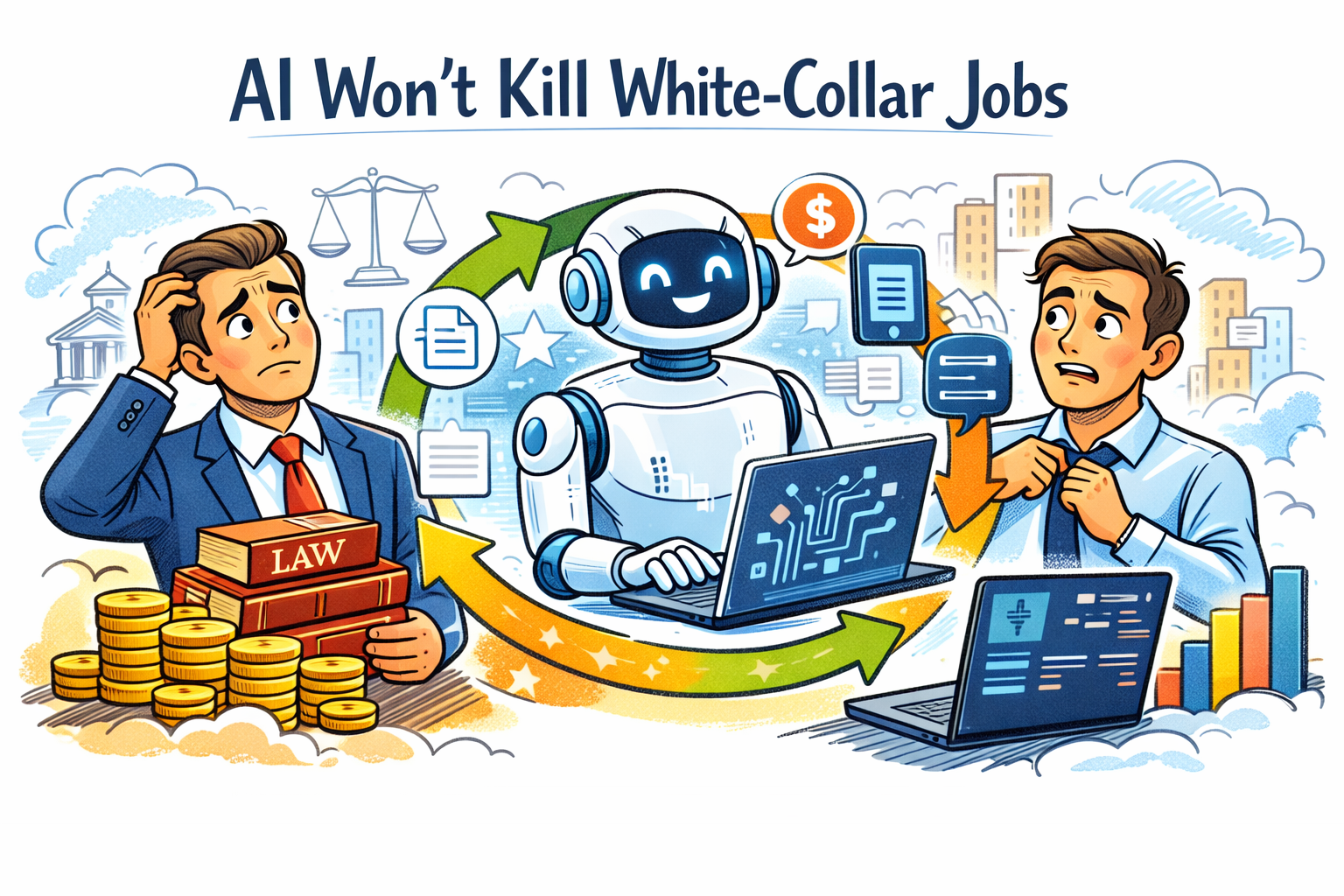
For the first time in decades, automation anxiety has moved from factory floors to office desks.
Lawyers see AI drafting legal documents.
Developers see AI writing code.
Designers see AI generating interfaces.
Consultants see AI producing analysis.
And the conclusion many people jump to is simple:
“If AI can do my job, then my job will disappear.”
It sounds logical.
But history suggests something different.
The mistake we keep repeating
Whenever a new technology dramatically improves productivity, we tend to assume demand will stay the same.
If a machine can do the work of ten people, then we assume nine people will lose their jobs.
But that assumes something that is rarely true: that the amount of work in the economy is fixed.
History shows that when productivity increases, something else happens.
Demand expands.
The computer example
In the early days of computing, there was a belief that the world would only need a handful of computers. At the time, that wasn’t a ridiculous assumption. Computers were enormous, expensive machines used primarily for scientific calculations.
The mistake was not misunderstanding the technology.
The mistake was assuming demand would stay the same.
Once computers became cheaper and more accessible, entirely new uses emerged: personal computing, the internet, smartphones, cloud computing, and countless digital services nobody could have predicted.
Today we carry several computers with us every day.
This pattern repeats itself throughout technological history.
New capability does not simply replace existing work.
It creates entirely new categories of work.
AI as a creativity amplifier
AI dramatically increases what individuals can accomplish with digital tools.
A developer can prototype faster.
A product team can run more experiments.
A designer can explore more ideas.
A lawyer can analyze documents in minutes rather than hours.
But the most important effect may not be efficiency.
It may be creativity.
When the cost of exploring ideas drops, people try more things. They experiment more. They combine ideas in new ways.
This is where new inventions come from.
The iPhone is a good example. Before it existed, very few people felt a need to carry a powerful computer in their pocket. But once it appeared, it created entirely new categories of products and services: mobile apps, ride sharing, mobile payments, social platforms, and countless others.
The demand did not exist first.
The invention created the demand.
AI may accelerate this process dramatically by making it easier for individuals and small teams to explore ideas and turn them into real products.
New jobs will appear
Every technological wave creates new types of work that previously did not exist.
AI is already doing this.
We are beginning to see roles such as:
- Prompt engineers, specializing in interacting with AI systems effectively
- Data curators, preparing and structuring high-quality training data
- AI auditors, ensuring models behave correctly and ethically
- Human-AI interaction designers, shaping how people work with intelligent systems
- Model evaluators, testing and validating AI output
Many of these roles barely existed a few years ago.
More will emerge as AI becomes embedded in everyday tools and workflows.
The real shift: asking better questions
One thing I have been saying for the past few years is this:
When you can get an immediate answer to almost any question, the real skill becomes asking the right question.
If answers become cheap, questions become valuable.
This applies to many knowledge professions. The differentiating skill is no longer just producing answers, but defining the right problems, framing the right questions, and interpreting the results.
AI can generate answers.
Humans still need to decide what is worth asking in the first place.
The AI Creativity Loop
I like to think about the impact of AI as a reinforcing loop:
- AI increases individual productivity
- The cost of building things drops
- More people experiment with new ideas
- New inventions emerge
- Entirely new markets appear
- Economic activity expands
Which then feeds back into even more productivity and experimentation.
Illustration
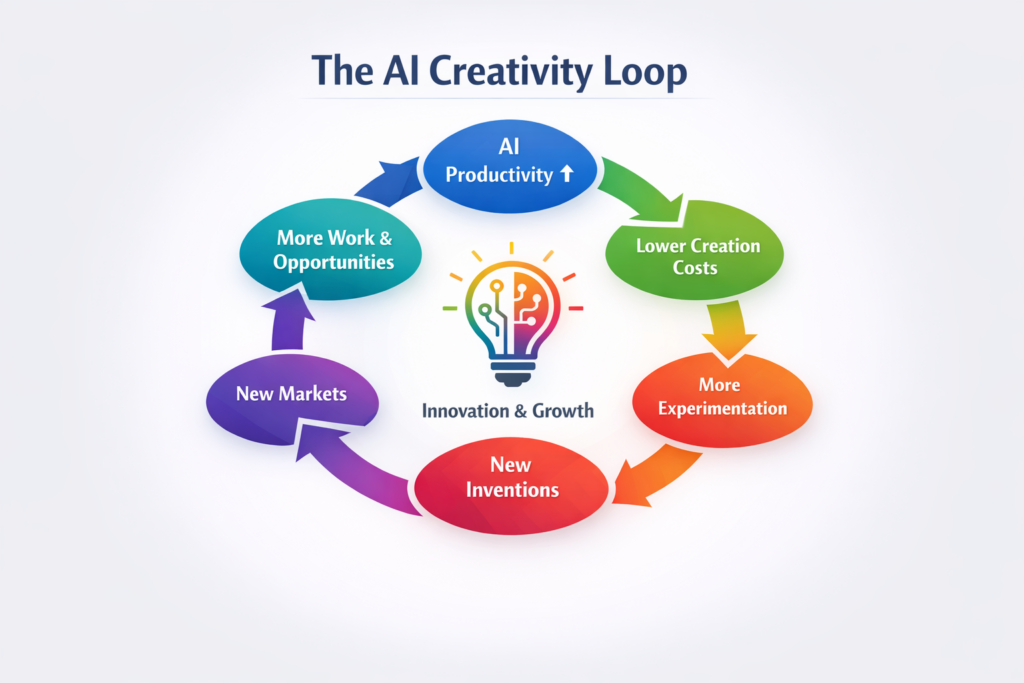
The important point is that this loop does not reduce economic activity.
It expands it.
The noise problem
There is one legitimate concern.
If AI makes it extremely easy to generate content, products, and services, we may see an explosion of low-quality output.
But the same technology that generates information can also filter it.
AI is extremely good at ranking, summarizing, and recommending information. Spam filters already work this way. Search engines do too.
In the future, personal AI assistants may help filter news, research, products, and services based on our preferences.
AI will both increase the amount of information and help us navigate it.
The real scarcity
If AI significantly increases our ability to create products and services, the real constraint in the economy may shift.
Not production capacity.
But attention, trust, and judgment.
In a world where almost anything can be generated instantly, the real value may lie in identifying what actually matters.
Which brings us back to the fear that started this conversation — that AI will eliminate white-collar jobs.
History suggests a different outcome.
Technology rarely removes work.
It expands what humans can imagine building.
And when the cost of creating drops, creativity explodes.
Leave a Reply