

Executive Summary


In July 2024, Cernel, an AI-driven platform for eCommerce content creation, faced a critical juncture. Despite strong technical capabilities, they struggled to secure investment, clearly communicate their value and which direction to choose from a large cloud of potential features and ideas. Through a focused eight-week engagement with ProductBooster/Mikael Flensborg, Cernel transformed from a feature-focused startup to an outcome-driven business, successfully securing pre-seed funding that exceeded their initial targets.

Company Background and Initial Situation
Cernel developed an innovative AI platform that automates content creation for eCommerce websites, optimizing product and category descriptions based on customer search behavior and existing data from the customer. Their solution helps eCommerce businesses improve organic traffic and reduce dependency on paid advertising.
Key Assets
Despite being at a critical juncture, Cernel possessed significant strengths:

- Exceptional Team
- Brilliant founders with out-of-the-box thinking capabilities
- Self-awareness about product development experience gaps
- Strong willingness to learn and adapt
- Growth mindset and openness to guidance
- Promising Solution
- Early indicators of product-market fit
- Strong technical foundation
- Innovative approach to eCommerce content
- Quick customer adoption when engaged

However, several critical challenges also needed to be addressed:
- Feature-Centric Focus: Strong technical solution but unclear business benefits
- Communication Misalignment: Single technical-heavy pitch deck for both investors and customers
- Investor Disconnect: Difficulty securing pre-seed funding due to unclear value proposition
- Untapped Potential: Strong product-market fit evidenced by quick customer adoption, but limited reach
- Unclear Direction: Multiple possible paths without clear direction and prioritization framework
The ProductBooster Engagement

Assessment and Objectives
ProductBooster by Mikael Flensborg, began with a comprehensive assessment of Cernel’s strategy and positioning. Key objectives were established:
- Implement The Product Operating Model and empower the team to embrace this mindset
- Secure pre-seed investment
- Develop comprehensive product strategy
- Improve stakeholder communication
Pivotal “Aha” Moment
A transformative insight emerged when facing a crucial decision between::
- Developing a mass-market SaaS solution
- Creating a customized enterprise solution
ProductBooster reframed this choice as more than just a market strategy decision. It represented three fundamental dimensions:

- Operational Model
- SaaS → Product Operating Model
- Enterprise → Project Operating Model
- Team Fulfillment(Critical Addition)
- What would the team be passionate about building?
- Which path would they find most fulfilling?
- How would each choice align with their personal and professional aspirations?
- Business Impact
- Different scaling patterns
- Distinct revenue models
- Varying resource requirements
Most importantly, ProductBooster emphasized that while business metrics and market opportunities were important, the team’s passion and desire should be the primary consideration. This human-centric perspective was transformative – shifting the conversation from purely business calculations to include what would make the team excited to come to work each day.
The insight helped Cernel understand that their choice would impact not just their market approach and operational structure, but also their daily satisfaction and long-term fulfillment as a team. This holistic view of the decision, incorporating both business and human factors, enabled them to make a choice that was not only strategically sound but also personally meaningful.
This moment exemplified ProductBooster’s comprehensive approach to strategic guidance – considering not just what could work in the market, but what would work for the people building it.
Implementation and Solution
The implementation focused on five key areas:
- Vision and Outcome
- Defining clear business objectives
- Establishing measurable outcomes
- Creating value-based metrics
- Opportunity/Solution Mapping
- Creating opportunity/solution trees for each key outcome
- Identifying customer opportunities before brainstorming solutions
- Mapping multiple solution options to each validated opportunity
- Using trees to visualize and prioritize value streams
- Establish Dynamic Roadmap based on outcomes and opportunities
- Strategic Communication
- Developing separate investor and customer narratives
- Focusing on outcomes rather than features
- Creating clear value propositions
- Team Alignment
- Introducing continuous discovery and delivery
- Setup of necessary Persona descriptions for continuous development and maintenance.
- Mapping features to outcomes
- Building outcome-driven mindset
- Metric Framework
- Establishing North Star Metric
- Defining business wide key performance indicators
- Establishment of Objectives and Key Results (OKR) for each Outcome

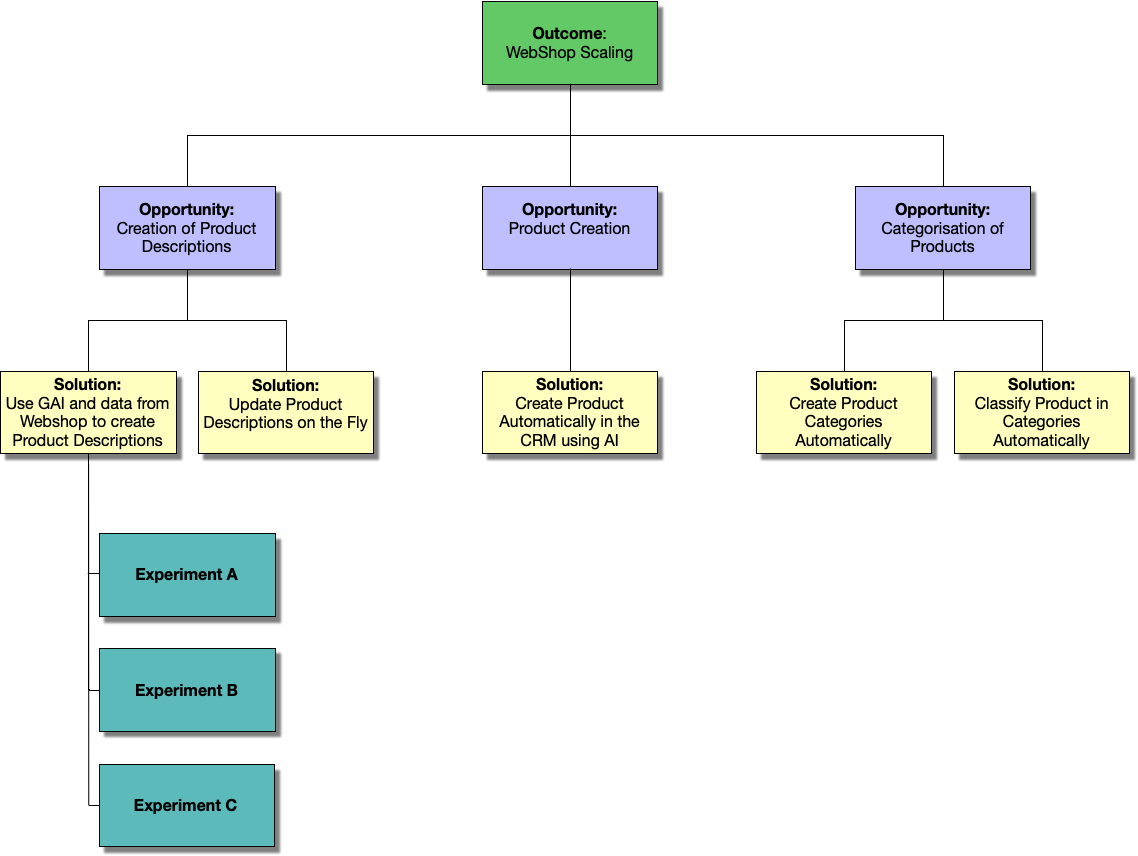
The implementation of The Product Operating Model at Cernel wasn’t just about introducing new processes or frameworks—it represented a fundamental shift in how the team approached product development and value creation. Through the systematic application of opportunity/solution trees, outcome-based thinking, and clear strategic communication, the team developed a new capability to distinguish between customer needs and potential solutions, enabling them to make more informed and impactful decisions.
Setting the Stage for Success
What made this implementation particularly effective was its focus on sustainable change rather than quick fixes. By emphasizing the understanding of underlying principles over the rigid application of tools, Cernel’s team was empowered to own their transformation. The careful balance between structure and flexibility allowed the team to adapt the model to their specific context while maintaining its core principles. This approach ensured that the changes would outlast the engagement and continue driving value as Cernel grew and evolved.
Results
The eight-week engagement, operating on a 12-hour per week schedule, delivered significant results:

- Investment Success
- From zero investor commitment to secured pre-seed funding
- Exceeded target valuation
- Better-than-anticipated investment amount by almost 300%
- Team Empowerment
- Confidence in making strategic decisions
- Ability to independently identify opportunities vs. solutions
- Ownership of product strategy and roadmap
- Sustainable practice of outcome-driven thinking
- Self-sufficient in applying The Product Operating Model principles
- Organisational Transformation
- Clear strategic direction
- Improved team alignment
- Enhanced operational efficiency
- Established growth foundation
The empowerment of the team proved particularly valuable as it ensured the sustainability of the transformation beyond the engagement period. The team didn’t just learn new processes – they internalized a new way of thinking that would continue to drive value long after the engagement ended.
Lessons Learned
Key insights from the engagement:
- The Opportunity-Solution Distinction
- Teams naturally gravitate toward solutions before fully understanding opportunities
- The ability to separate customer needs from potential solutions is a learned skill
- Regular practice and reinforcement are needed to maintain this distinction
- This separation enables better decision-making and more effective product strategy
- Structure in Chaos
- Framework provides clarity
- Starting point for action
- Clear decision-making process
- Mindset Over Tools
- Focus on thinking patterns
- Simple, practical approaches
- Sustainable transformation
- Value of Clear Direction
- Outcome-driven decision making
- Aligned communication
- Sustainable growth path


The Path Forward
These lessons from the Cernel engagement underscore a fundamental truth about product strategy transformation: Success comes not from following a rigid playbook, but from embracing the right mindset and applying structured thinking to navigate complexity. The most powerful transformations occur when teams are empowered to make this mindset shift themselves, guided by clear frameworks but driven by their own understanding and motivation.
The journey from chaos to clarity isn’t about perfect execution of processes or adoption of tools – it’s about building the capability to think differently about problems and opportunities. When companies internalize this approach, they create lasting value that extends far beyond any single engagement or initiative.
Conclusion

The transformation of Cernel demonstrates how the right strategic guidance at a critical moment can fundamentally alter a company’s trajectory. What began as a technically strong product struggling to find its market voice evolved into a well-positioned startup with clear direction and secured funding—all within a focused eight-week engagement.
Key Takeaways
The Cernel case illustrates two fundamental principles of successful product strategy:
- The power of choosing the right operating model based on team aspirations and capabilities, not just market opportunities
- How outcome-driven thinking transforms feature-focused technical teams into fast moving value-creating organizations
Impact Beyond Numbers
While the successful pre-seed funding round provides tangible validation of the transformation, the true value lies in the lasting changes to Cernel’s approach to product strategy. The shift from feature-focused to outcome-driven thinking has equipped the team with:
- A sustainable framework for decision-making
- Clear methods for identifying and validating opportunities
- The ability to articulate value effectively to different stakeholders
This case study serves as a powerful reminder that transformative change doesn’t require months or years of consultation. With the right guidance and mindset, significant results can be achieved through focused, strategic engagement. The key lies not in the duration of the engagement, but in the fundamental shifts in thinking and approach that it catalyzes.
Cernel’s journey demonstrates that successful product strategy isn’t about choosing between technical excellence and market understanding—it’s about aligning both under a clear, outcome-driven vision. When technical teams embrace this mindset and are empowered to drive their own transformation, they unlock their full potential to create lasting value for both customers and stakeholders.
“Working with Mikael has been transformative for Cernel. His approach to the product operating model, centered on outcome-based strategy, not only refined our direction but also empowered our entire team. We now have a shared vision that aligns everyone, from developers to stakeholders, fostering ownership and proactive problem-solving.”

Andreas Busch
CEO & Co-founder, Cernel.ai