

From WAP and Flash to Agentic AI. Why the biggest opportunity might not be where everyone is looking.
In my previous two articles, I’ve explored how AI is changing software engineering and Product Management. One was about the lessons we can learn from the history of programming paradigms. The other was about how AI changes the economics of building software and the implications for Product Management.
But there’s another aspect of the current AI revolution that I find increasingly interesting.
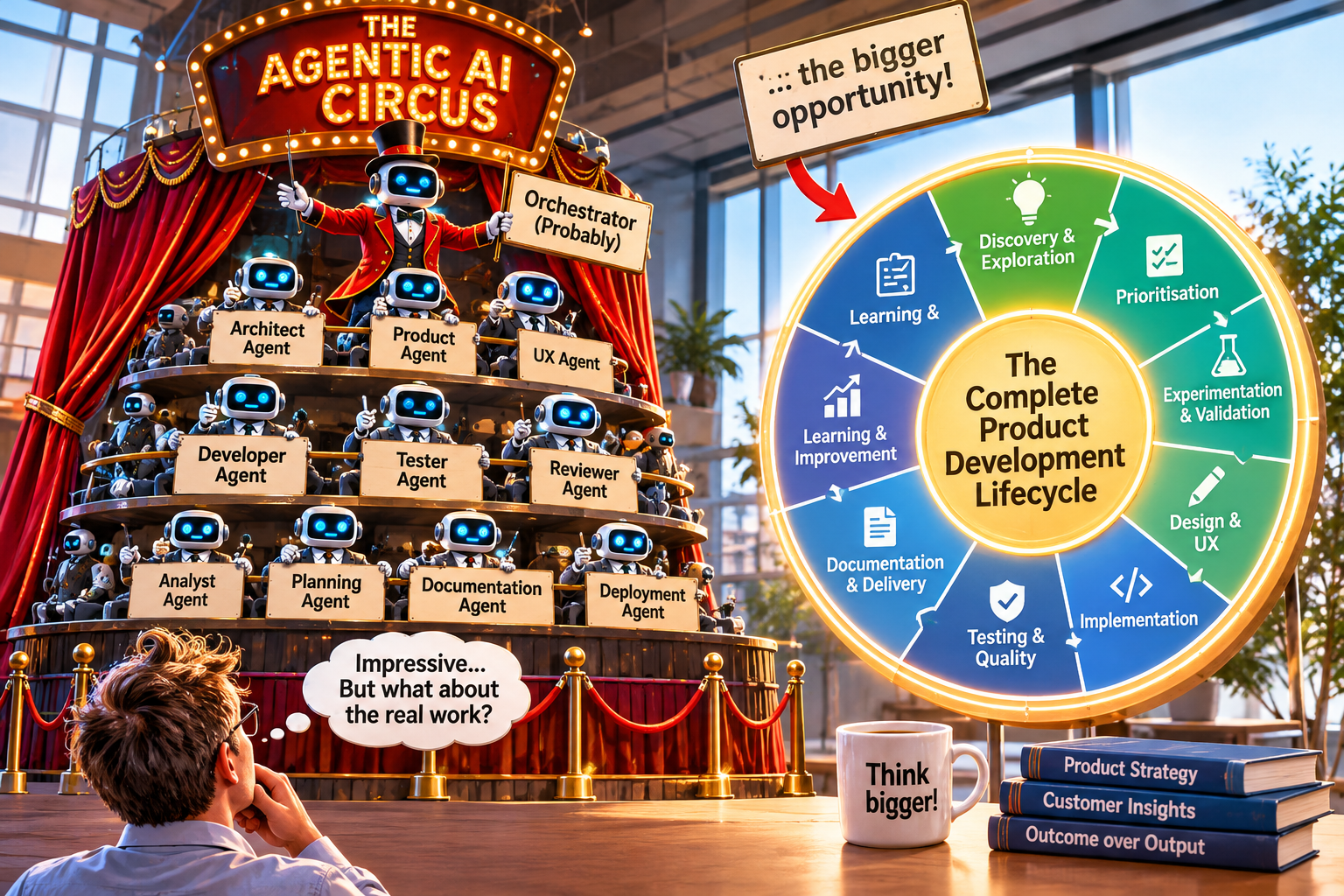
If you spend some time on LinkedIn, you might get the impression that the future of software development depends on how sophisticated an agent architecture you can put together. Everybody seems to be an expert in agentic programming, demonstrating elaborate hierarchies of specialised agents, orchestrators, sub-agents and frameworks.
We have agents acting as architects, UX designers, developers, testers and reviewers. Then we have other agents coordinating these agents, making sure they communicate properly, and presumably another agent somewhere making sure the entire agent organisation is following its OKRs.. I’m exaggerating, of course. But only slightly.
Don’t get me wrong. I genuinely believe AI is revolutionary, and agentic architectures will certainly have their place. But I sometimes wonder whether we’re becoming so fascinated with the technology itself that we’re overlooking a much bigger opportunity.
Perhaps we’re focusing too much on automating software implementation, while missing the potential to transform the entire product development process.
Here we go again. Remember the next big thing?
I’ve been around the software industry long enough to have experienced quite a few technologies that were going to change everything.
Remember WAP? Everything was going to move to mobile internet. Except that browsing the internet on a tiny monochrome screen, navigating with numeric keys and waiting for pages to load wasn’t quite the experience we had imagined.
Then came Java Applets. Applications running directly in your browser! No more installing desktop software. Well, apart from the Java Runtime Environment, which your system administrator first had to install and maintain. We had successfully eliminated the need to install an application by introducing the need to install an application runtime.
And of course, Flash. The entire web was going to become a multimedia experience. Animated websites, interactive applications and games everywhere. Until Apple decided that Flash wasn’t coming to the iPhone, HTML5 evolved, and Flash eventually disappeared.
We also had SOA, Grid Computing, Web 2.0, Blockchain, the Metaverse and plenty of other technologies that were supposed to fundamentally change the way we work and interact with software.
Some succeeded, some found their natural place, and others quietly disappeared. That doesn’t mean they were bad technologies. Quite the contrary. Many of them contributed important capabilities that we still use today.. But there’s a recurring pattern in our industry. We discover a new technological possibility, become fascinated by what it can do, and gradually start looking for problems to justify using it.. I sometimes wonder whether we’re doing exactly the same thing with AI.
Welcome to the Agentic AI circus
One example is the increasing fascination with elaborate multi-agent architectures.
The idea is certainly appealing. Instead of having one AI agent do everything, we introduce specialised agents with different responsibilities. An architect agent defines the solution, a UX agent designs the interface, developer agents implement the functionality, and testing agents validate the result.. And the best part: An orchestrator coordinates the entire operation.
It sounds impressive. And in some scenarios, it might actually be a very good approach.. But does adding more agents and more layers of orchestration necessarily improve the result? I recently came across an interesting research paper from EPFL and Apple that addresses precisely this question.
In How Much of a Harness Does a Strong Agent Need for Autonomous ML Engineering?, Kirill Brilliantov, Alejandro Hernández-Cano and Emmanuel Abbé compare increasingly elaborate agent frameworks with a much simpler coding-agent setup.
The researchers tested these approaches on autonomous machine-learning engineering tasks, using the same underlying language model and comparable time budgets, and the results were rather interesting. The elaborate frameworks provided no advantage over the simpler single-session baseline in the tested benchmarks. In fact, the authors argue that much of the additional machinery becomes redundant when the underlying model is sufficiently capable.
Read the original Apple/EPFL research.
Of course, this doesn’t prove that multi-agent architectures are useless. The study has a specific scope, and there are plenty of other scenarios where specialised agents and orchestration might provide real benefits.. But it does raise an interesting question.
Are we sometimes confusing architectural sophistication with actual results?
I’ve seen plenty of impressive diagrams showing dozens of agents collaborating in increasingly complicated hierarchies. They look fantastic in presentations. But I’d really like to see more evidence of the value they create compared with simpler alternatives.
Perhaps we should spend a little less time designing agent org charts and a little more time figuring out what we’re actually trying to improve.
Software development is more than writing code
And this brings me to what I believe is the much bigger opportunity.
When discussing AI in software development, most of the attention seems to be directed towards implementation. How can we generate code faster? How can we automate architecture? How can we get agents to build entire applications?
However, product development is a much broader discipline.. Think about everything that happens between identifying a customer problem and delivering a successful product improvement.. We need to discover opportunities, understand customer behaviour, explore alternatives, investigate the market, formulate hypotheses, prioritise, experiment, refine solutions, plan, design, review UX, implement, test, document, deliver and learn.
These activities aren’t independent steps in a linear process. They are interconnected and continuously influence each other.. And AI has the potential to change virtually every one of them.
Consider some examples.
Product Discovery and Exploration
We can use AI to analyse enormous amounts of customer feedback, support conversations, interviews, reviews and behavioural data. Instead of manually going through hundreds of individual inputs, we can identify patterns, emerging problems and opportunities that might otherwise remain hidden.
We can explore markets, investigate competitors, challenge assumptions and generate alternative perspectives.
Of course, AI-generated insights still need validation. But the ability to explore much larger information spaces can be incredibly valuable.
Experimentation and Refinement
We can generate prototypes and explore alternative solutions much faster. AI can help formulate hypotheses, suggest experiments, generate test data and analyse the results.
Instead of spending weeks preparing an experiment, we might be able to explore several alternatives in a fraction of the time.. And perhaps more importantly, we can afford to investigate possibilities that previously weren’t worth the investment.
Planning and Architecture
AI can help analyse dependencies, explore architectural alternatives, identify potential risks and challenge proposed solutions.
It can also help teams understand unfamiliar parts of an existing system, which is particularly valuable in complex legacy environments.
UX and Design
AI can help review user journeys, identify inconsistencies, explore alternative interaction patterns and generate prototypes. It can also help analyse usability feedback and identify friction in existing experiences.
Testing and Quality Assurance
Beyond generating test cases and writing automated tests, AI can help explore edge cases, analyse failures, identify patterns in defects and investigate unexpected behaviour.
Documentation and Delivery
Documentation has traditionally been one of those activities that everyone agrees is important, but nobody particularly enjoys maintaining.. AI can help keep documentation aligned with implementation, generate release notes, explain changes and communicate technical information to different audiences.
Learning and Product Improvement
Perhaps one of the most interesting opportunities is the ability to continuously analyse product usage, customer feedback and application metrics.
AI can help connect quantitative and qualitative information, identify unexpected behaviour and suggest areas where further investigation might be valuable.
The list could be much longer.
The important point is that AI isn’t just a coding assistant. It can become a capability that supports the entire product development process.
From automating tasks to transforming the process
I think there’s an important distinction between using AI to automate individual tasks and using AI to fundamentally improve how the entire process works.
We have traditionally organised product development around specialised roles, handovers, tools and activities. Product Managers discover and define opportunities, designers explore solutions, architects define technical approaches, developers implement them, testers validate them, and so on.
Of course, modern empowered product teams already work differently, with considerable overlap between these responsibilities. But there are still many organisational and practical boundaries. And AI gives us an opportunity to challenge some of these boundaries.
Imagine a product team where customer feedback, product analytics, market information, technical architecture and development tools are connected through AI capabilities.
A team could identify an emerging customer problem, investigate the underlying causes, explore potential solutions, generate prototypes, evaluate alternatives, develop experiments and analyse the results.
Not necessarily through one enormous autonomous agent hierarchy, but through a combination of AI capabilities integrated into the team’s daily work.
The objective wouldn’t be to remove human involvement from every activity. Quite the contrary. It would be to give the team better information, more alternatives and faster feedback, enabling them to make better decisions.
And this is where I think the real transformation could happen.
Not simply making individual tasks faster, but reducing the friction between activities and shortening the learning cycles across the entire product development process.
We haven’t found our level yet
I genuinely believe we’re witnessing a revolutionary shift. And I suspect we’re only scratching the surface of what will become possible.. But I don’t think we’ve found our level yet.
We’re still experimenting with different approaches, discovering new capabilities and figuring out where the technology creates genuine value.. Some of today’s agent frameworks will probably become important building blocks. Others will find much narrower applications than their creators currently imagine. And some will probably disappear altogether.. That’s perfectly normal. It’s how technological evolution works.
What I would like to see is less fascination with how sophisticated our AI architectures can become, and more attention to how effectively we can improve the complete product development lifecycle.
We should be asking where AI can help us discover better opportunities, explore more alternatives, experiment faster, make better decisions and learn more effectively.. And perhaps we should also be a little more ambitious about what we mean by AI-assisted product development.. Because software implementation is only one part of building successful products.
The next big AI opportunity might not be building software autonomously. It might be fundamentally changing how we discover, develop and improve products.
And I think that’s a much more interesting challenge than figuring out how many agents we can fit into an architecture diagram.
Leave a Reply